
The Office: Somehow We Manage
East Side Games StudioSimulation
3.45.87K Reviews
- Version
- 1.46.1
- Installs
- 1.00M
- Age Rating
- Teen
Screenshots


Our Review of The Office: Somehow We Manage
 Analysis by Appyee
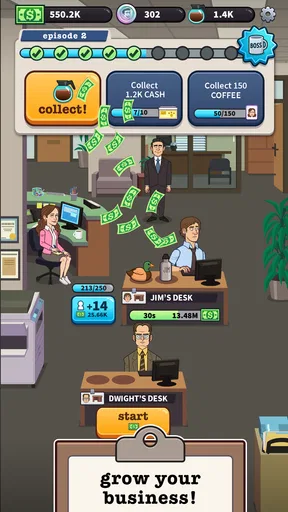
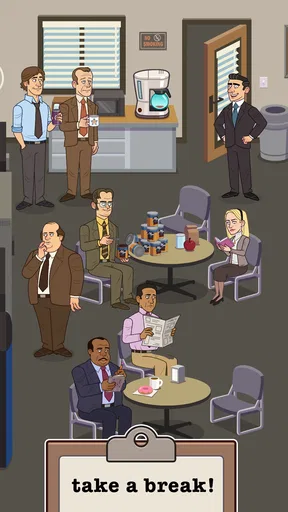
I went into The Office: Somehow We Manage expecting a light idle game built around familiar characters, and that is exactly where it works best. It turns the Scranton branch of Dunder Mifflin into a small, constantly moving workplace that earns cash while I am away, then gives me short bursts of management to handle when I return. The appeal is less about deep simulation and more about seeing a recognizable sitcom setting translated into a simple mobile routine.
That simplicity is both the game’s strongest quality and its biggest limitation. I can open it for a quick check, collect progress, improve the office, and leave again without needing a long uninterrupted session. At the same time, anyone looking for a detailed business simulator, a competitive strategy game, or a story-heavy adaptation may find the systems too light. My overall impression is that this is a comfortable fan-oriented idle game, best enjoyed in small visits rather than treated as a serious management challenge.
How the Scranton office feels in its current state
The basic loop is easy to understand. I help Michael Scott and the rest of the office generate in-game cash, then use that progress to keep the operation moving. The idle structure means the game is designed around returns: I make decisions, close the app, and come back later to see what accumulated. That makes it a natural fit for a commute, a coffee break, or the few minutes before bed.
What gives the routine its personality is the setting. Instead of managing an anonymous factory or a fantasy kingdom, I am working with the recognizable workplace associated with The Office. Michael’s presence gives the game a comic center, while the Dunder Mifflin theme makes ordinary upgrades and cash collection feel more specific than they would in a completely original idle title.
I would not describe the experience as a full recreation of the television series. It is better understood as a casual simulation wearing The Office’s characters and atmosphere. The license supplies the immediate appeal, but the long-term question is whether I enjoy incremental progress. If I do, the familiar setting makes the repetition pleasant. If I do not, the references alone are unlikely to carry the game for very long.
The game is free to download, which makes trying the opening loop straightforward. It is rated Teen, so parents should consider that age guidance before handing it to younger children. The game is also available for devices running Android 7.0 or later, a relatively broad requirement that should suit many older Android phones, although actual smoothness can still vary with a device’s hardware and available storage.
On the Android store, it has passed one million installs, with an average rating of 3.4 from roughly twenty-six thousand ratings and about five thousand nine hundred written reviews. Those figures suggest a sizeable audience but also a divided response. That matches my experience: the concept is immediately approachable, yet the idle format and its monetization can be less appealing once the novelty of the setting settles.
The first sessions are welcoming, but the loop soon becomes familiar
The opening works because there is very little friction in understanding what to do. I do not need to learn a complicated economy before seeing progress. The office produces cash, I improve the operation, and the next target becomes visible. This is useful for players who want a relaxed game rather than a demanding tutorial or a large set of interlocking menus.
After the initial excitement, the rhythm becomes more predictable. The important decision is not usually “what grand strategy should I use?” but “where will my next improvement make the current cycle feel better?” That can still be satisfying, especially when I enjoy watching small gains add up, but it does mean the game depends heavily on my tolerance for repetition.
One practical habit helps: I try to collect and reinvest with a purpose instead of tapping every available improvement immediately. When several upgrades are visible, comparing their effect on the next return is more useful than simply choosing the cheapest button. This does not transform the game into a complex strategy title, but it makes each short visit feel more deliberate and reduces the sense that I am only following prompts.
What the developer’s current build tells me
The developer is East Side Games Studio, and the current version is 1.46.1. The release date shown for the game is January 26, 2022, so this is not a brand-new launch trying to prove its concept. It has had time to establish its identity as a licensed idle simulation, and the current build is the one prospective players should judge rather than an early version remembered from launch.
That version number is useful context, but I would not treat it as proof of a particular feature or a guarantee of a specific future direction. A later build can reflect maintenance, balancing, content work, or a mixture of changes, and the number alone does not explain how every update affects play. What I can say is that the game remains positioned around its established office-management loop instead of presenting itself as a new genre experiment.
For someone who played earlier, the main question is whether the current routine still feels rewarding after returning. Existing players should expect the same fundamental identity: an idle game with The Office as its setting, not a complete redesign into a conventional strategy simulator. That continuity is reassuring if the original loop suited you, but it may also mean that returning will not solve frustrations caused by slow progress or repetitive tasks.
I also think the current build should be approached with realistic expectations about evolution. A mature mobile game can become more polished or adjust its balance without changing the central reason people play it. If I already liked checking in on the Scranton branch, a current install makes sense. If I left because I disliked idle progression itself, a version update is unlikely to change that basic relationship.
How I would use it during an ordinary day
My most natural routine is to open it during a short break, collect the office’s accumulated cash, review the next useful improvement, and close it once the immediate decision is made. I do not need to reserve an hour for it, and I can return later without losing the thread. That makes it more convenient than a traditional simulation that expects continuous attention or lengthy building sessions.
A second useful routine is to play it alongside a television rewatch. The setting becomes more enjoyable when I already have The Office in mind, although I would keep expectations modest: the game is a companion piece, not a replacement for the show. It gives me a playful reason to revisit the characters, but it does not offer the same kind of scene-by-scene comedy or narrative pacing.
For a busy player, the idle design can be forgiving because progress does not depend entirely on constant tapping. For a player who wants to make every decision personally, that same design can feel passive. I often prefer to check in at planned moments rather than repeatedly reopen the app, because frequent checking can turn a relaxing game into a small obligation.
One trade-off is especially important: the game’s best use case is short, casual attention, but its progression can encourage me to think about returning more often. I recommend setting a personal stopping point. Once I have collected, made the meaningful upgrade, and seen what the next target requires, there is usually little value in forcing another session immediately.
Where spending changes the feel of progress
The game is free, but it includes in-app purchases ranging from $0.99 to $99.99 per item. That range matters because idle games naturally create moments when I want to speed up a wait or reach the next improvement sooner. The temptation is built into the structure: progress is visible, the next goal is close, and spending can make the distance feel smaller.
I can recommend trying the game without paying first. That gives me enough time to decide whether the office theme and the idle rhythm are genuinely enjoyable or whether I am only reacting to the first novelty. If the free loop already feels slow or repetitive, purchases are unlikely to fix the underlying issue; they may only move me through the same pattern faster.
For players who do spend, I would treat purchases as convenience rather than a requirement for understanding the game. The sensible question is not whether an item accelerates progress, but whether the amount feels worthwhile for the number of short sessions I expect to have. A large purchase makes little sense if I may stop playing after the licensed setting loses its freshness.
This is also where the game differs from a traditional premium simulation. A paid, self-contained alternative usually asks for money at the start and then lets me focus on its systems without the same recurring pressure to accelerate. A free idle game offers a lower entry barrier, but I need more discipline around optional spending. That distinction should guide the choice more than the presence of familiar characters.
What works for fans and what does not
The strongest part is the way a mundane office becomes a reason to keep checking in. Dunder Mifflin is a good match for idle design because the fantasy is not about saving a kingdom; it is about keeping a workplace productive, improving the flow of business, and watching cash accumulate. The contrast between a paper company and a game built around constant progression gives the concept its charm.
I also like that the premise is easy to explain to another fan. I do not need to describe a complicated backstory before someone understands why Michael Scott and the Scranton branch are involved. That accessibility makes it a reasonable recommendation for a casual The Office fan who wants something familiar on a phone.
The weakness is that recognition can hide how little depth the management side offers. Seeing a beloved character does not automatically create meaningful choices. When the best action is obvious, the office can feel more like a themed progress screen than a living simulation. Players who want staffing trade-offs, detailed budgets, unpredictable business problems, or a branching narrative should look toward a more substantial management game instead.
Another limitation is the emotional distance between the source material and the mobile format. The television series depends on timing, awkward conversations, and character interaction. An idle economy depends on accumulation and repetition. The game can evoke the workplace, but it cannot reproduce the exact reason the show is funny. I enjoy it more when I treat the references as decoration and context rather than expecting a complete sitcom experience.
How it compares with other idle and simulation choices
Compared with a generic idle game, this one has a much clearer personality from the moment it opens. The Office theme gives my progress a recognizable frame, and that can be enough to make routine upgrades feel more inviting. The cost of that focus is that the game’s appeal is narrower: if I do not care about the setting, there is less here to separate it from other incremental titles.
Compared with a deeper business simulation, it is far easier to pick up but far less demanding. I do not choose it when I want to study a complex market, plan a detailed production chain, or manage consequences that unfold over a long strategic campaign. I choose it when I want a light office-themed activity that can be paused at almost any point.
Compared with a premium game, the free entry is its clearest advantage. I can test the concept without committing at the start. The disadvantage is the presence of optional purchases and the possibility that the pace may feel designed around waiting. Players who strongly prefer transparent progression and a single upfront price may be happier with a paid alternative, even if it lacks The Office branding.
Compared with a story-led adventure based on the same show, this is a much more repetitive and hands-off experience. Its purpose is not to deliver a new episode. It is to give me a small system to revisit. That makes it better for background play and short breaks, but worse for anyone hoping for substantial dialogue, exploration, or a beginning-to-end plot.
Who should install it, and who should pass
I would recommend it to fans who enjoy idle games and want a familiar workplace theme around the numbers. It is also a good fit for people who prefer games that can be played in brief visits, especially those who like returning to see accumulated progress rather than completing a long mission in one sitting.
It may suit a casual player who has never spent much time with simulation games. The central idea is approachable, and there is no need to master a large system before getting involved. The Teen rating should still be taken seriously by families deciding whether it is appropriate for a younger player.
I would skip it if I find idle mechanics boring, if I dislike waiting for progress, or if I want every action to have a significant strategic consequence. I would also choose another game if my main goal is a faithful interactive version of the show’s comedy. The setting is the hook, but the gameplay remains an incremental simulation.
Players with limited patience for purchase prompts should decide in advance whether they are comfortable ignoring optional offers. My practical approach is to play without spending until the routine has proved that it deserves more time. That protects the decision from the excitement of seeing familiar characters and makes it easier to judge the actual game underneath the license.
What returning players and new players should watch
New players should watch how quickly the loop becomes comfortable or tiresome. The first few visits can feel rewarding simply because the office is new, so I would judge the game after the novelty has faded. If I still enjoy planning the next improvement and checking the branch later, the format is probably a good match.
Returning players should watch the balance between progress and patience in the current build. The version number shows an established product, but it does not remove the need to decide whether the present pace feels fair to me. I would revisit with the expectation of continuity, not a completely different game.
Everyone should watch their own spending pattern. The listed purchase range reaches from small impulse amounts to a much larger single item, so setting a limit before playing is more useful than deciding in the middle of a frustrating wait. The best experience, in my view, comes when purchases remain optional and the free routine is still enjoyable on its own.
I would also watch whether the licensed setting continues to add value after the first week. If the characters and office atmosphere keep making routine progress feel pleasant, that is a genuine strength. If I start seeing only timers, cash totals, and upgrade prompts, a more mechanically rich simulation may be the better use of my time.
My final view is positive but measured. The Office: Somehow We Manage is an accessible, free simulation for short sessions, and East Side Games Studio has chosen a setting that gives a familiar idle formula a clear identity. I like it most as a small companion game: something to check between other activities, not a substitute for a deep management title or a new episode of the show.
Its limitations are just as clear. The loop can become repetitive, spending can make waiting more noticeable, and the sitcom license cannot create strategic depth by itself. Still, if I am a fan of The Office and already enjoy incremental games, I think it is worth trying without paying first. The right expectation is simple: manage a playful version of the Scranton branch, enjoy the familiar atmosphere, and decide based on whether the routine remains fun after the initial recognition wears off.
Verdict
Strengths of The Office: Somehow We Manage
- Faithfully captures the humor and characters of the TV series.
- Simple controls make it easy to play in short sessions.
- Many familiar scenes and references reward longtime fans.
- Idle mechanics provide progress even when you are away.
- Regular tasks and events help keep the gameplay moving.
Limitations of The Office: Somehow We Manage
- Progress can become heavily dependent on waiting or spending currency.
- The gameplay loop may feel repetitive after the initial chapters.
- Some upgrades and bonuses are locked behind in-app purchases.
- Requires an internet connection for most features and progress.
- Battery use can increase during longer play sessions.
Other Releases by East Side Games Studio
View All
Trailer Park Boys:Greasy Money
Simulation4.6

RuPaul's Drag Race Superstar
Simulation4.3
Similar Picks in This Category
View All
Truckers of Europe 3
Wanda Software4.3

Town Building Life Simulator
XGame Global4.2

Fidget Toys Trading・Pop It 3D
Freeplay Inc4.7

Sculpt People
CrazyLabs LTD4.4

Scary Teacher 3D
Z & K Games4.2

Hair Tattoo: Barber Shop Game
CASUAL AZUR GAMES4.3
Frequently Asked Questions
What is The Office: Somehow We Manage?
The Office: Somehow We Manage is a casual mobile management game inspired by the television series The Office. You take charge of Dunder Mifflin’s Scranton branch, complete office tasks, upgrade workstations, and help familiar characters improve productivity. Its presentation uses recognizable humor, characters, and situations from the show, making it especially appealing to fans who want a light, story-driven game rather than a complex business simulator.
How do you play The Office: Somehow We Manage?
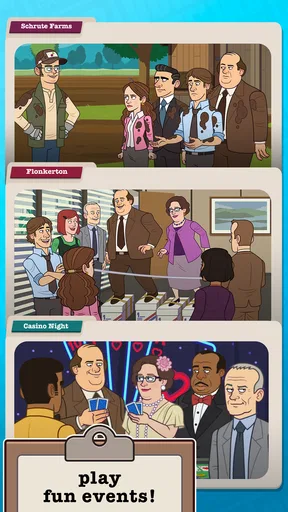
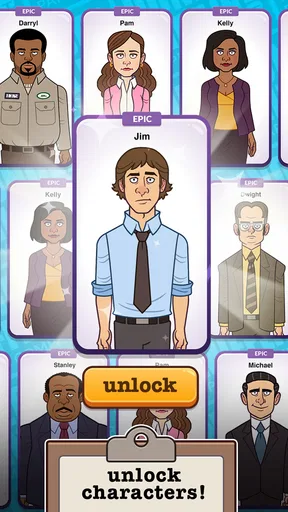
Gameplay revolves around tapping through office activities, collecting resources, completing objectives, and investing in upgrades that increase your branch’s earnings. You can unlock and manage characters from the series, participate in events, and progress through story content based on memorable workplace moments. The controls are simple and suitable for short sessions, although advancing efficiently requires planning upgrades and returning regularly to collect rewards.
Is The Office: Somehow We Manage free to download?
The game can generally be downloaded for free, but it includes optional in-app purchases. These purchases may provide premium currency, bundles, boosts, or other conveniences that help you progress faster. You can play without spending money, though free progression may feel slower during certain stages or events. If children use the device, it is worth enabling purchase restrictions before starting.
Can I play The Office: Somehow We Manage offline?
The Office: Somehow We Manage is designed around live events, reward collection, account progression, and other features that may require an internet connection. Some actions might appear available temporarily without a connection, but reliable access is normally needed for the complete experience and for synchronizing progress. Connecting to the internet before launching the game also helps prevent missed rewards or synchronization problems.
Is The Office: Somehow We Manage suitable for fans of The Office?
Yes, the game is primarily aimed at fans of The Office who enjoy its characters, jokes, and workplace setting. The familiar cast and references give the experience much of its appeal, while the management mechanics remain easy to understand for casual players. However, players looking for deep strategy, extensive customization, or a fully offline game may find the gameplay relatively repetitive after the novelty of the show’s presentation wears off.
Play our best games!


